

Introduction
Issues such as infinite reboot loops, failure to power on, or system errors in mobile phones are typically linked to abnormal system firmware, chip damage, or failed software updates; they may also be triggered by improper disassembly or repair attempts. Modern repair practices typically integrate both software and hardware diagnostics—utilizing tools such as JCID Schematic Software and DFU recovery utilities—to rapidly determine whether the root cause lies in a software glitch or a motherboard hardware issue, thereby guiding the decision on whether to proceed with chip-level repair. This diagnostic-first approach to repair effectively enhances repair efficiency and minimizes the risk of misdiagnosis or erroneous repairs.
Preparations Before Mobile Motherboard Repair
Before starting any restoration on a cell motherboard, proper training is especially important as a small mistake can completely damage sensitive components The first step is to ease the work area and ensure proper grounding using an anti-static mat bracelet. A dust-free and temperature-controlled environment helps avoid accidental short circuits with sensitive ICs. Technicians also combine isopropyl alcohol (ninety%) and a gentle nylon brush to clean oxidized areas of the countertop.
Safe dissection requires plastic pry tools and a set of precision screwdriver blades to open the body without tools. Once the motherboard is removed, examine it under a microscope at 10x–40x magnification to detect burn marks, corrosion, or broken solder connections At this stage, a Motherboard Test Fixture is useful as it allows the board to operate securely without fully assembling the phone is helpful
Detailed Steps to Repair Mobile Motherboard
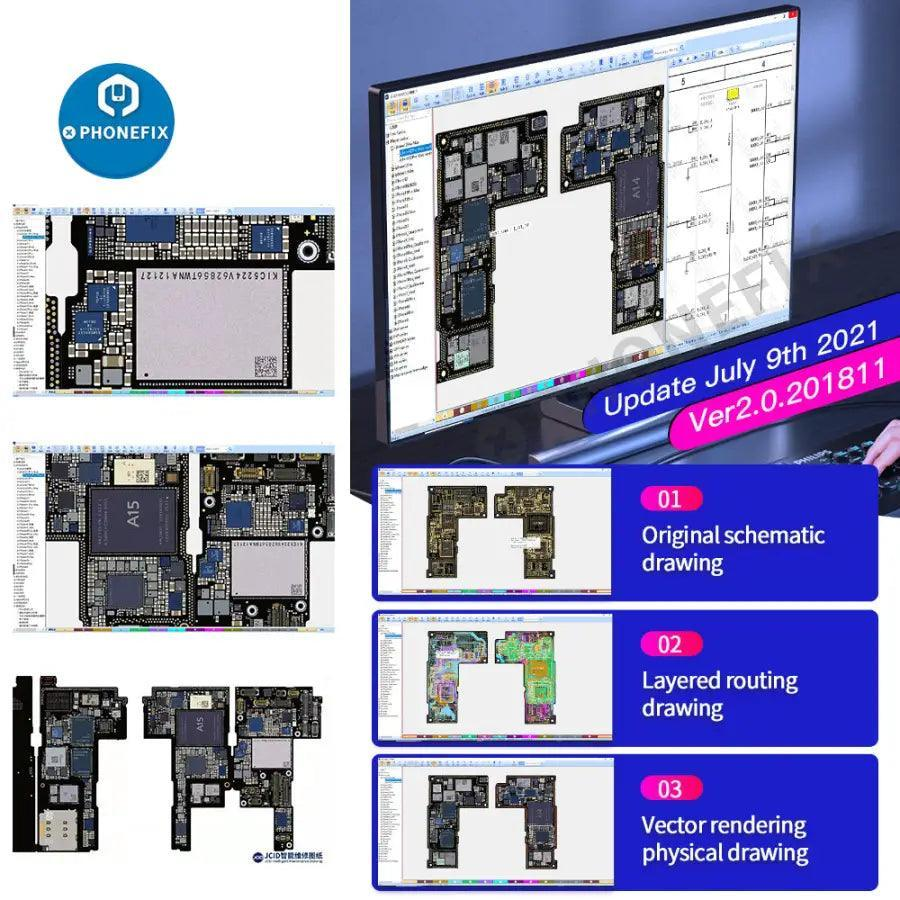
The repair process begins by calculating the fault on the cell motherboard through the use of JCID Schematic Software, which provides digital maps of circuit traces, voltage points, and IC connections Once the schematic is analyzed, technicians locate the fault and instruct the use of a multimeter in continuity and diode mode. If a short circuit is detected, thermal imaging or alcohol droplet testing can help identify the heating components.
Hot air rework station settings are critical to avoiding faulty ICs. A temperature change of 320°C to 380°C is often used, depending on the type of IC, while the airflow is kept moderate to prevent blowing near the additives A special copper nozzle is often recommended for special temperature control. Curved ESD-safe tweezers are used to gently lift the IC as soon as the solder melts. Stream selection is equally important; no-easy flux gel is preferred because it improves solder float and reduces oxidation throughout the heating process. After the defective component is removed, the pads are installed using a soldering iron and a low-temperature soldering iron at approximately 280°C .
Equipment Usage and Software Diagnostics in Processing
Modern cell therapy is tightly dependent on a combination of hardware, software, and program equipment. The JCID Schematic Software knowledge-history plays a key role in motherboard layouts and in identifying test factors for voltage shaping. It helps technicians observe the symbol paths from the electrical IC to the CPU, leading to faster and more accurate fault identification. Similarly, the DFU Mode Tool is used when devices routinely fail additionally, especially after a failed update or incorrect firmware flash.
Where there are firmware issues, firmware flashing repair will be essential using specialized flashing equipment that repairs separate devices and documents Many technicians also rely on Software Diagnostic Tools to research device logs and error codes before starting a physical restore. These tools reduce futile page switching and help diagnose the problem as software corruption or hardware failure. In the best repair shops, a motherboard test setup is hooked up to simulate battery and electrical conditions, which allows for real-time diagnostics without fully setting up the smartphone .
Post-treatment testing and verification
After refining aspect replacement or reballing paintings, checking out is an important step to ensure the cell motherboard is working properly. The processed board is first powered by a set of controlled DC power supply ranging from 3.7V to four.2V depending on battery specifications. Current draw is monitored; A solid early modern shows perfect boot response, and unusual spikes suggest terminal faults involving shorted capacitors or faulty PMIC wiring .
Next, the use of the board’s DFU Mode Tool is tested to verify the hit firmware dialogue. If the device goes into recovery or DFU mode effectively, it indicates that the CPU and NAND communique currents are solid. Technicians also check the charging function, community identification and display output before the very last meeting. At this stage, retesting using JCID Schematic Software ensures that each treated circuit is consistent with the expected voltage reading. The device will only be safely reassembled after all practical effort Using genuine screws and heat pads.
Conclusion:
By 2026, mobile phone motherboard repair has evolved into a sophisticated engineering discipline that integrates software analysis, precision temperature control, and micro-soldering techniques. Leveraging tools such as JCID schematics, DFU flashing utilities, and specialized test fixtures, technicians can rapidly diagnose software anomalies or hardware damage, enabling the systematic repair of complex motherboard faults. When combined with standardized reflow soldering protocols and dynamic current testing procedures, this approach significantly boosts the success rate of chip-level repairs, thereby facilitating a more stable, efficient, and modern standard of in-depth motherboard servicing.
